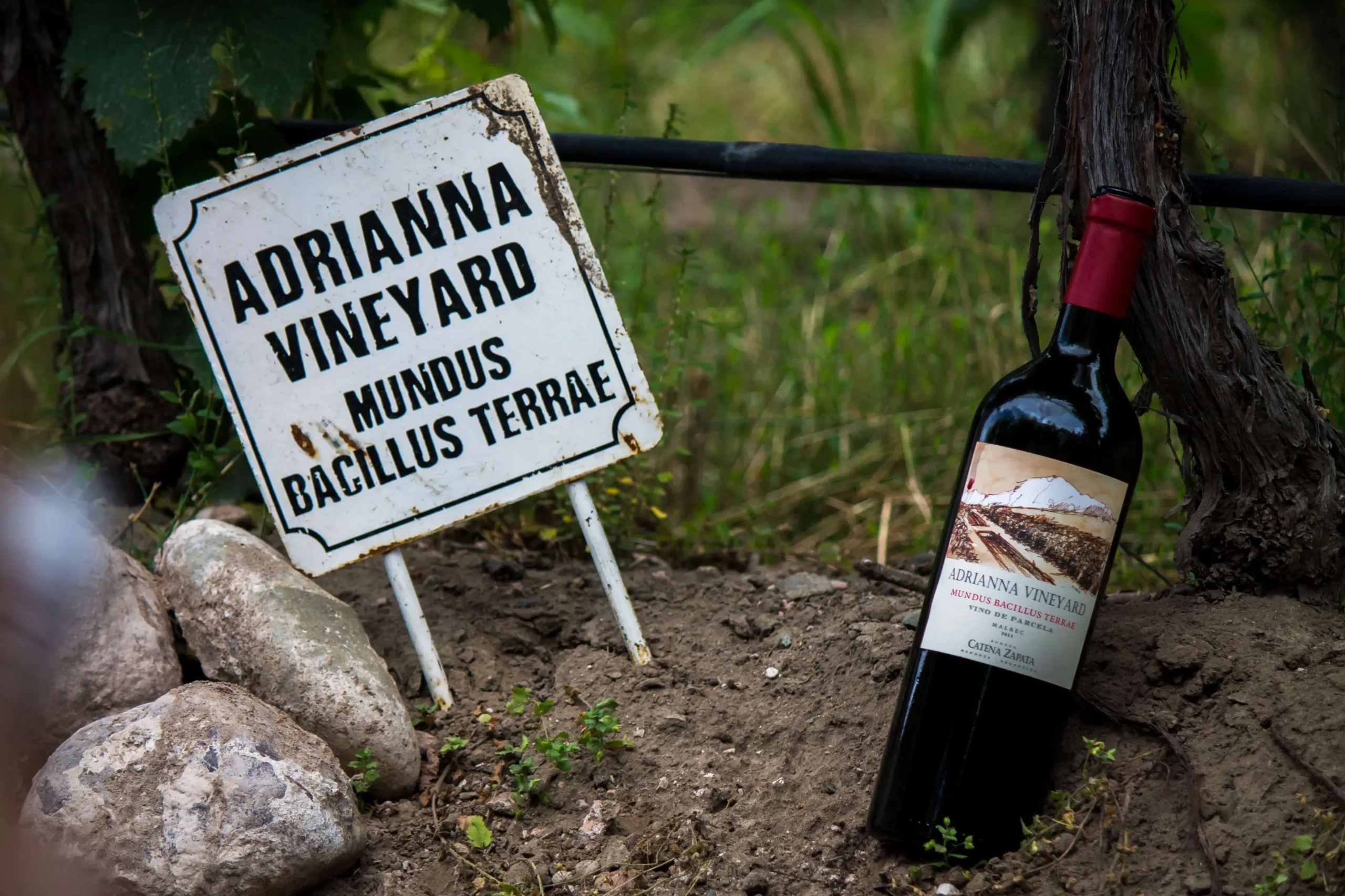
There’s a phrase that resonates across the Argentine wine industry, and beyond: Adrianna Vineyard is referred to as the “Grand Cru” of South America. It’s the conclusion that sommeliers, critics, scientists, and wine professionals around the world have reached, through different paths, after three decades of observation. Luis Gutiérrez, the Spanish critic for Robert Parker’s Wine Advocate, summed it up in a single line about the Adrianna Vineyard: “Words do not do justice to this beauty.”
Adrianna Vineyard is the answer to a question Nicolás Catena Zapata asked himself in the early 1990s, after returning from a trip to Bordeaux with his daughter Laura. A French producer tasted his Cabernet Sauvignon and said it reminded him of a warm-climate wine, with no aging potential. Nicolás’s reaction wasn’t defensive. It was pragmatic: he went back to Mendoza and asked his team to find the coldest possible site in the province. The answer was Gualtallary, Monasterio, in the upper reaches of the Uco Valley. No one had planted vines there before. No one thought it was possible to ripen grapes there. In 1992, against every recommendation, Nicolás planted anyway.
The Site Where Wine Shouldn’t Exist
Adrianna Vineyard sits at roughly 1,460 meters (4,790 feet) above sea level in Gualtallary Monasterio, the highest cultivatable part of the Uco Valley. When Nicolás Catena Zapata planted the Adrianna Vineyard, Mendoza’s most respected viticulturists warned him the grapes wouldn’t ripen. In Winkler Scale terms — the U.C. Davis system that measures heat accumulated above 10°C during the growing season — Adrianna falls between zone 1 and zone 2 depending on the vintage, placing it climatically between Burgundy and the coolest parts of Bordeaux.
Luis Reginato, Catena Zapata’s director of viticulture, describes the team’s first read on the site with precision: “We quickly understood that this vineyard was different from anything else in Mendoza. And we also understood that it was different from anything else in the world.” What makes Adrianna unique isn’t altitude alone. It’s the convergence of factors that rarely coincide in a single place: limestone-rich soils formed by the uplift of the Jaboncillo hills, a gentle slope that reduces frost risk, an elevation of roughly 1,460 meters that lowers temperatures, and high-intensity UV-B light — let through by the thinner atmosphere — that forces the vine to produce more phenolic compounds, such as anthocyanins and polyphenols.
The Soil That Explains Everything
Adrianna’s geological history begins in the Eocene, more than 50 million years ago, when the formation of the Andes and accompanying volcanic and seismic activity shaped the subsoil. That bedrock of volcanic and igneous rock, later covered by marine deposits and then by glacial alluvial sediment, produces exceptional drainage: no matter how hard it rains, water percolates deep below the surface.
On top of that base, Adrianna’s topsoil is extraordinarily heterogeneous. Over the years, Catena Zapata has vinified hundreds of wines from distinct parcels across the vineyard, and that experience has shown that soils can shift significantly within just a few meters. The Jaboncillo hills, perpendicular to the Andes and geologically younger, lifted the surrounding terrain through seismic faulting and gradually forced the river that once ran through the area southward, leaving behind a series of terraces with varying concentrations of limestone, gravel, and calcium carbonate.
The direct enological consequences of that heterogeneity are well documented. White Bones and White Stones, Adrianna’s two single-parcel Chardonnays, come from soils just 50 meters apart. Yet they are radically different wines. White Bones’ soil retains more water, producing more vigorous vines, a denser canopy that shades the fruit, and wines with more herbal aromatics and intensity. White Stones, with more direct sun exposure, ripens earlier and produces a wine with greater volume on the palate. That two parcels separated by 50 meters yield such different wines, vintage after vintage, isn’t an enological curiosity — it’s the precise definition of terroir.
Science as Instrument
What sets Adrianna apart from other exceptional vineyard sites worldwide isn’t only what it produces, but the depth of scientific understanding behind its diverse soils and broader ecosystem. In 1995, Laura Catena founded the Catena Institute of Wine with a specific goal: to elevate the region to the first tier of world wine. Adrianna Vineyard has since become the Institute’s primary subject of study, with findings shared openly with the scientific community and the global wine industry. To date, the Institute has published 40 peer-reviewed papers in collaboration with universities and research centers around the world.
One widely cited study, published in Scientific Reports (Nature), analyzed the phenolic profiles of Malbec produced across 23 parcels in 12 geographical indications in Mendoza over three consecutive vintages, under standardized winemaking conditions. The results confirmed that terroir is scientifically measurable: wines from different sites could be distinguished by composition alone, even when winemaking was identical. Gualtallary showed the highest concentrations of anthocyanins and other phenolic compounds of any zone studied.
Another line of research established the role of UV-B light in high-altitude grape quality. The thinner atmosphere at sites like Adrianna allows a greater proportion of UV-B rays through, activating the plant’s defense mechanisms. The vine responds by producing phenolic compounds — tannins, anthocyanins, polyphenols — that act as a natural sunscreen. The result in the glass is greater complexity, stronger aging potential, and a tannic structure that’s difficult to replicate in lower-elevation vineyards using the same varieties.
The Wines That Prove It
All of this would carry little weight if it didn’t translate into the wines themselves. The evidence lies in three decades of vintage results. Adrianna Vineyard River Malbec received 100 points from Robert Parker’s Wine Advocate for both the 2016 and 2021 vintages — the first South American wine to score a perfect 100 from that publication — as well as 100 points from James Suckling for the 2017 and 2018 vintages. Mundus Bacillus Terrae has earned perfect scores from Jane Anson in 2019 and 2021, from Descorchados in three consecutive vintages — 2021, 2022, and 2023 — and from Falstaff in 2011. White Bones Chardonnay received 100 points from James Suckling for both the 2018 and 2022 vintages, as did Fortuna Terrae Malbec 2012. No other vineyard in South America has a comparable track record across this many independent rating systems: Adrianna now holds 13 perfect 100-point scores in total, making it the most awarded vineyard in South America.
The World’s Verdict
In 2023, The World’s 50 Best Vineyards — whose voting body is composed of wine trade professionals from across the globe — named Adrianna Vineyard the best vineyard on the planet. The following year, in 2024, it was inducted into the competition’s Hall of Fame. As of 2025, Mendoza is the most awarded region in the history of the ranking.
Nicolas Martianhes, sommelier and restaurant manager at Balvanera in New York, sums it up with the precision of someone who explains these wines to international guests every day: “This vineyard completely changed the way people understood the kind of wines Argentina could produce.”
The question Nicolás Catena asked himself after returning from Bordeaux — why not make a “Grand Cru” in Argentina? — has an answer. He found it in a place no one thought could exist: 1,460 meters above sea level, in the Andean foothills of Gualtallary, in soil that took 50 million years to form. It’s called Adrianna Vineyard, named after his youngest daughter.

Periodista, viajera full-time, especialista en Cultura, Negocios y Lifestyle.