Nobumasa Akiyama, professor at the School of Public Policy and International Studies and the Graduate School of Law at Hitotsubashi University, Tokyo, spoke for the second time this year with ReporteAsia, covering a range of topics including denuclearization, security, and Japanese and international politics.
The first occasion we met was in January, in Japan, when we visited the Land of the Rising Sun to conduct a series of interviews covering different aspects of Japanese geopolitics.
In this instance, the visiting researcher at the Japan Institute of International Affairs and member of The Asia-Pacific Leadership Network for Nuclear Non-Proliferation and Disarmament (APLN) was in Buenos Aires on his first visit to Latin America coinciding with the celebration of the «Exhibition on the Atomic Bombs and Peace of Hiroshima and Nagasaki: Towards 80 Years Since the Bombing.»
This is an event that has traveled to 58 cities in 20 countries since 1995, dedicated to keeping alive the memory of the nuclear attacks on Japan that marked a before and after in human history.
The opening of this exhibition also included a testimonial lecture by Teruko Yahata, a survivor or «Hibakusha» of the Hiroshima bomb. As for Professor Nobumasa, his agenda led him to participate in an academic meeting at the CARI (Argentine Council for International Relations), and to lecture at UNDEF (University of Defense) and the Faculty of Law of the University of Buenos Aires, all with a focus on denuclearization and security in East Asia.
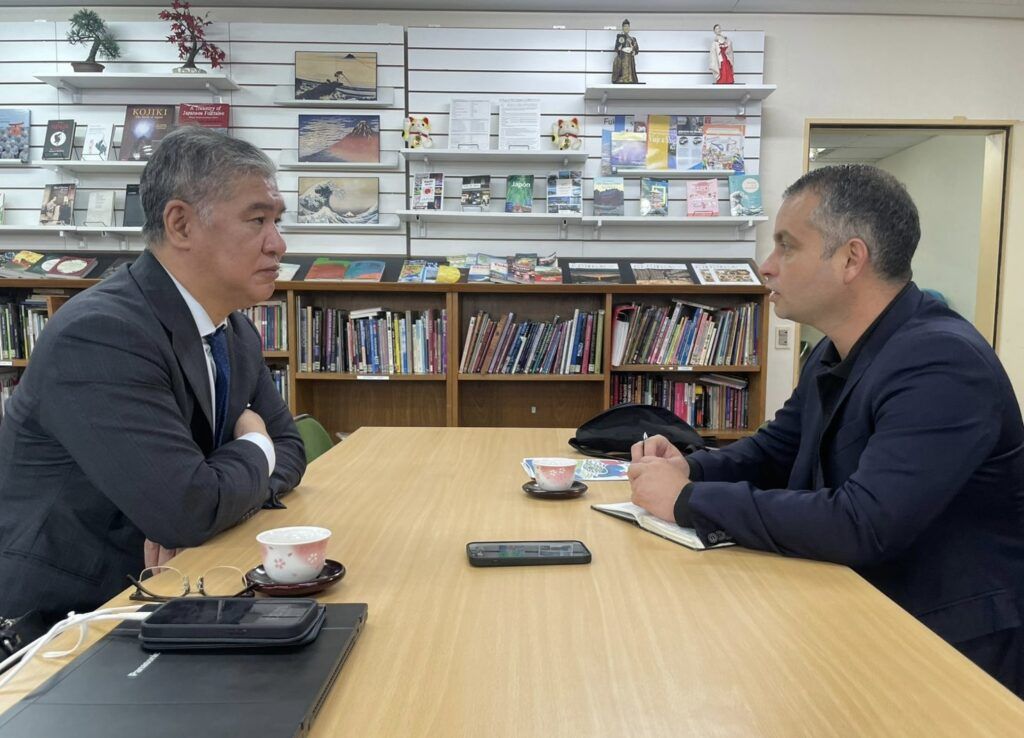
This second interview with Sensei Akiyama—held at the Cultural Center of the Japanese Embassy in Argentina—could not have come at a better time, as almost simultaneously with our conversation, the Nobel Peace Prize was being awarded to the Nihon Hidankyo entity, which brings together survivors of Japan’s atomic bombs. This award highlights the tireless commitment of the «Hibakusha» to nuclear non-proliferation, just as the war in Ukraine and the conflict in the Middle East rekindle the nuclear threat once again.
The recent identification of North Korean soldiers in Russia and Xi Jinping’s latest statements to his army calling for preparations for war, in relation to Taiwan, add tension to an already highly conflicted scenario. But that’s not all: the upcoming U.S. elections add another element of instability to the status quo in Asia, as does the BRICS summit currently underway in Russia, where the creation of an international currency alternative to the dollar is being proposed. Everywhere, the structures of international paradigms of power balance as we knew them are creaking.
In our first conversation in January of this year, Professor Akiyama Nobumasa warned us that, in this framework of generalized war, Japan does not rule out the hypothesis of an imminent threat «as long as nuclear weapons exist.» North Korea’s constant missile launches towards Japanese territory, as well as the growth of China’s nuclear arsenal (which is expected to reach 1,500 nuclear warheads by 2035), justify this position.
It must also be understood that there are territorial disputes in the region, which mark a geopolitical and diplomatic map full of sensitive topics.
Professor, what has changed geopolitically in these months since our first conversation?
The situation in Ukraine, and for the Ukrainians, is getting more complicated. At that time, when we first spoke, North Korea was providing artillery to Russia, and probably China was not sending weapons, but was sending materials to Russia for weapons production. In these months, the cooperation between China, Russia, and North Korea has become clearer. And they are taking a more assertive stance towards the Western world.
The case of Iran, which supports Hamas and Hezbollah, also poses a challenge in that if there is a direct conflict with Israel, the risk that Iran might opt for the nuclear option is an increasingly growing threat.
The situation regarding denuclearization is not improving. In Europe, the Middle East, and the Asia-Pacific region, the existence of nuclear weapons is increasing. We have to work together to remember the history of the use of nuclear weapons; eventually, this will lead to a world without these types of weapons.
With so many open fronts, where is Japan’s attention today in geopolitical terms?
We cannot compare the risks, but in principle, our strategy is to prevent the escalation of more assertive activities from China and North Korea. I don’t think they will use nuclear weapons because that is not the best strategy to achieve their goals. However, they continue to build up their nuclear arsenals. Therefore, it is likely that with more weapons, they will take more decisive stances against regional players, such as Japan, South Korea, and the Philippines.
This is the number one priority in terms of concern.
Then, the issue of the Taiwan Strait is another important matter. China’s moves against the status quo are worrying. Just a few weeks ago, China launched a long-range missile into the Pacific Ocean. And they have been conducting such tests in recent times within their own territory. That’s why it wasn’t as widely known that Beijing also tests missiles. This time the international community noticed because it was launched into the sea. They did this to demonstrate that they have intercontinental capabilities.
Why do it now? Before conducting these tests, China notified the United States, Australia, and New Zealand, and it’s worth noting that it was known that the Chinese missile hit exactly where they had predicted; this was also done by Beijing to show these countries the technological capabilities it possesses.
This is not surprising: we know that China is developing its arms production and diversifying its medium and long-range missiles, nuclear submarines, mobile launch platforms, and missile silos that operate intercontinental ballistic missiles (ICBM). So, with all this, we believe they are strengthening the survivability of their nuclear arsenal.
El buque de las fuerzas de defensa japonesas navega por primera vez a través del estrecho de Taiwán
Japanese Presence in the Taiwan Strait
It was reported that last September 25th, a Japanese Maritime Self-Defense Force ship, the destroyer Sazanami, crossed the Taiwan Strait for the first time, along with Australian and New Zealand ships.
This Japanese operation in the South China Sea underscores the significance of this region for Tokyo, where China also has conflicts with the Philippines over islets and archipelagos of the Paracel Islands and Spratly Islands, with recent incidents between ships from those countries escalating into serious episodes. In fact, Japan is also facing China’s attempt to change the status quo by force around the Senkaku Islands.
Our strategy is to prevent the escalation of more assertive activities on the part of China and North Korea.
As Professor Akiyama explains about the presence of the Japanese ship in the Taiwan Strait: «Some criticized that this action took a long time to materialize because the Taiwan Strait is a central part of our sea-land communication, so the passage should not be blocked by any state in the region; that was the signal we gave. If China were to attempt it, that would be a concern not only for Japan but for the international community.»
«This was done now because Chinese ships have recently increased their presence and are passing closer to areas near Japanese islands at a time when there are sovereignty claims. I don’t think it’s appropriate to dismiss international law and have planes violate Japanese airspace; that was very provocative on China’s part, although, in fact, Russian planes have also recently flown over our territory,» he added. He refers to the Tu-95 bomber that entered Japanese airspace in the south of Okinawa and around the Izu Islands south of Tokyo last September.
What Does the Territorial Conflict Between the Philippines and China Imply for Japan?
The conflict between the Philippines and China is a long-standing one. How it evolves will depend on the Philippine government, whose leadership is somewhat friendly with China, although tensions over territory definitely exist.
For Japan, this conflict must be resolved not by force, but through dialogue. That is the central principle of all international bilateral relations. And this is precisely one of the principles that Russia violated, we are talking about the pillars of the rule of law: not using force to resolve conflicts, whether international or domestic. What is happening in Ukraine goes against international law, breaking the principle of sovereignty, the core of any state.
This also applies to the Philippines. Some reports from the Philippines say that China is pushing harder by deploying a greater military presence. Although it is not a direct conflict, with its actions, China is seeking to implant the idea that force, power, can change the status quo even without the support of the international community.
What Can You Say About Japan’s Relationship with South Korea on Security Issues?
Japan agrees with the United States deepening its ties with South Korea within the framework of the bilateral Security Treaty they maintain, which is integrated with trilateral cooperation between these two and Japan. Thanks to this joint effort, the exchange of information is becoming more extensive among the parties.
The next steps involve defining contingency plans in case of Security crisis scenarios in the region. It is clear that Japan, by its Constitution, cannot exercise collective security with another state. The case is that Japan could only exercise collective defense with the United States, because we are military allies, and I believe South Korea would also be cautious not to have Japanese Self-Defense Forces on its own territory. We still need more discussions and confidence-building.
ReporteAsia en Hiroshima: dialogando con un sobreviviente de la bomba atómica
On Japanese Politics
The recent resignation of Fumio Kishida as Prime Minister was surprising, especially for the West. But the interviewee helps us understand that Kishida’s decision was expected and that his departure was due to the dynamics of Japanese domestic politics: «It may have happened due to certain scandals involving political financing in his party, the Liberal Democratic Party (LDP). He was taking a lot of abuse over this issue.»
«Many politicians from that party were criticized for issues of embezzlement, but Kishida was clean; however, he took responsibility for the situation as the party leader. And as the elections are approaching, it must have seemed better to him to have new leadership and to hold the elections under a new guide; that was his political calculation.
What is your perspective on the new Prime Minister Ishiba Shigeru?
He is not mainstream, he comes from a minority, he was elected for being popular with the public, but not so much within the Party or among politicians. Also for having proposed many interesting dialogues concerning security and financial policies.
In the case of security, he proposed to negotiate with the UN to revise the Japan-US security agreement, so that Japan’s influence could be increased in some legal aspects of the bilateral relationship, such as over the conduct of American soldiers in Okinawa, where they have been involved in crimes. In other words, he sought to give Japan more influence in these matters. He also tried to review other issues, such as the maintenance costs paid by Japan for the US military bases (totaling 120) in Japanese territory.
He also sought to evaluate changes in the status quo of defense in the region and to propose a NATO (North Atlantic Treaty Organization) style multilateralism in Asia Pacific, i.e. a multilateral security alliance.
What was the general reaction to these proposals?
It received serious criticism from American expatriates in Japan and the U.S. government. It also met with dissent from nations such as India, Indonesia and Southeast Asian countries. Simply because inserting a NATO-type security model in the Pacific would be a very drastic change. Many thought it was an unrealistic model, for many reasons. First, Japan has conditioned its exercise of the right of collective self-defense, as we have already said.
Moreover, in a NATO-type architecture, if one of the members is attacked, then Japan would have to join the fight in its defense, and that is impossible due to its current political circumstances, which do not allow it to do so. And secondly, other countries in the region do not like the idea either, because if we had this kind of multilateral arming in this area, potentially the adversaries would be China or North Korea. However, most countries in Asia have a strong trade relationship with China, and they don’t want to take a hostile attitude towards Beijing.
What is to be expected in the upcoming general election on October 27?
We do not know what may happen, but Ishiba has to rethink his security strategy, although he is not against the alliance with the United States. When he gave his first speech, the content of the speech was aligned with Kishida’s policy, and he expressed that he was not going to depart from the conventional line of Japan’s policies. It is important that he take it one step at a time, without giving wrong signals to allies.
Japan’s general election on Sunday, October 27, will be a test for the new prime minister, who is seeking to consolidate his position at the head of a party plagued by internecine politics. He will have to be tougher on those who join him in the administration of funds. At most, if he cannot keep his political allies in the ruling coalition, the Komeito party, and loses close colleagues, and if the elections are negative for him, then there is a good chance that his leadership will be in crisis.
Sensei, how do you see Japan’s relationship with Argentina?
It is very promising in strategic issues. Japan identifies the issue of critical minerals, lithium, etc., and their stable supply as one of the essential priorities for the development of new technologies. In this sense, we seek to ensure that this supply does not become complicated and we also seek to increase Argentina’s supply chain capacity.
We know that Argentina wants to add more value added, to develop its industry in this sector, to receive investment. The problem on the Japanese side is that our companies are probably not at the best moment and that the Chinese are looking to enter Argentina with a more robust proposal.
Do you think that Argentina’s relationship with China complicates Japan?
No, Argentina has its own national development strategy, and it should take advantage of both Japan and China to balance its growth. But the markets in the world are very tough, so Argentina has to see how to increase its competitiveness. It is important for all the companies in Japan, or the factories in Argentina, to study the trends, to analyze the market forecasts, to see what is the next business scenario that will prevail.
If you want to make a lithium battery, the market is oversupplied, in China, in Europe, in the United States, and it is decreasing, while the demand for hybrid cars is increasing.
On the other hand, we are happy to know that the relationship with Washington represents a pillar of Argentina’s international policy, that also unites us as countries. That is why we need to cooperate to avoid crises that may arise from the upcoming U.S. elections.

Co-fundador de ReporteAsia.